It's OK to Do Things Differently!
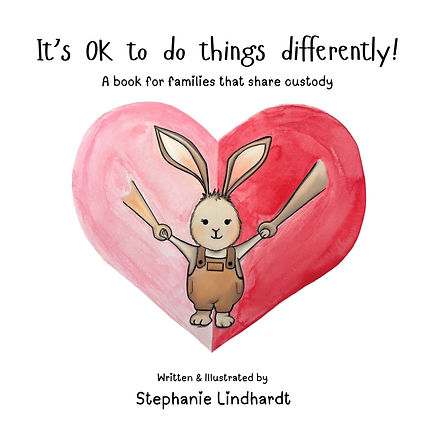
"This book is invaluable for children adjusting to different family dynamics, as it emphasizes flexibility, respect, and the empowerment of self-discovery. The repetative message, "It's OK to do things differently!" is a powerful reassurance that every child can embrace both parts of their family without confusion or guilt. A wonderful resource for parents and a comforting read for young children learning to feel secure in their unique family story." - Alyson Ford, AMFT



"I'M THE BETTER PARENT"
By Stephanie Lindhardt
An art piece dedicated to the psychological constructs and behind-the-scenes behavior of Parental Alienation

An explanation of the art so you can better understand the symbology throughout:
The mother is depicted staring into a mirror that the child is holding for her while she adoringly gazes up at her mom, both of them oblivious to the poison surrounding their hyper-intense bond. The mother whispers constant statements of fear and rejection about the Dad while she puppeteers various realms to hyper inflate the vilification of him in order to reaffirm the fear and hatred to the child and those within their exclusive circle. I added a full array of color and beauty to create an illusion of perfection from afar… you must look closely and analyze the piece in order to see the underlying bizarre reality that exists throughout. The bubbles float with the Psychological terms that umbrella the various behaviors. Personally, I love psychological terms because not only do they explain the behavior, they offer insight for healing. I represented this behavior between mother and child, but it can also exist between father and child, and sometimes even between grandparent and child. This behavior is called, "Parental Alienation", and it is a severe form of psychological abuse.
Parental Alienation is where one parent manipulates the child to turn on and violently reject their once loved parent, usually during or after a high conflict divorce or separation.
It is not to be taken lightly. Whether intentional or not, it is a form of psychological abuse that severely affects the child's development and attachment style for the rest of their lives.
The proof of abuse lies in the symptoms of the child, not the behavior of the manipulative parent. I cannot stress this enough!
This is because the child's behavioral, emotional, and psychological state serves as the direct, tangible evidence of the harm inflicted. While a manipulative parent's actions (such as badmouthing or blocking access) are the cause, the child's reaction is the effect that demonstrates the damaging impact of that abuse. Too often these cases turn litigious with both parents blaming the other for abuse and trying to prove their own innocence while ignoring the tangible evidence of abuse presented in the child.
The symptoms in the child include:
UNREASONABLE HOSTILITY- Sudden, intense hatred or fear of the other parent, often with no basis in abuse
LACK OF GUILT- Showing no remorse or mixed feelings about mistreating the targeted parent. Normal feelings of conflict, sadness, or guilt that would typically arise from rejecting a loved one are suppressed or absent in alienated children, replaced by an unjustified certainty and coldness that often parrots their revenge filled parent's language, making it a significant red flag.
DEVALUATION OF THE ONCE LOVED PARENT- The child starts calling their once loved parent by their first name instead of "Mom" or "Dad", indicating emotional distancing, manipulation, or a loyalty conflict, often encouraged by the alienating parent to undermine the targeted parent's role and create separation. This can at times be accompanied by the child giving the parenting role to their new step parent and giving them the title instead.
This is a SIGNIFICANT red flag for signs of parental alienation as it is almost exclusively linked to PA.
REJECTION OF EXTENDED FAMILY- Suddenly cutting off the other parent's relatives and extended family members including once loved grandparents in addition to the once loved parent.
IDEALIZATION- Viewing the alienating parent as perfect and without flaw, and the targeted parent as entirely bad. Healthy unabused children hold nuances for both their parents, good and bad.
REWRITING HISTORY & FALSE MEMORIES OF ABUSE- Alienating parents may repeatedly tell children exaggerated or false stories of abuse, leading the child to internalize these narratives as their own memories. Children, especially if emotionally vulnerable, may go along with the alienating parent's version of events to gain approval or avoid conflict, creating memories that align with the alienator's agenda, eventually denying all positive past memories with the targeted parent.
If you believe your child is being psychologically abused in this way, seek out a trauma informed therapist for both yourself and the child and review your legal options.
Divorce and separation doesn’t have to be this way. Using innocent children as pawns in a game of revenge and control harms the child WAY more than it harms the parent you hate. Do not be so immature and emotionally disregulated that you resort to using your children as emotional pawns for revenge and control. Because ALL children deserve to love and be loved by BOTH sides of the family without the parental hate/shame/blame game going on in the background!
I commemorate this piece to erased parents everywhere, and to all the children suffering from this tragic and silent form of psychological abuse. Healing is possible, trauma informed therapy is a must, but it begins with awareness and I hope this piece does just that. -Stephanie Lindhardt